En
En
 Es
Es
by Admin
04-May-2026
Varanasi and Hindu Spiritualism- The Complete Guide for Western Travelers
There are destinations you visit, and there are destinations you experience. Varanasi belongs firmly in the second category, and every Western traveler who has ever walked its ghats knows exactly what that means. Talking about spiritual travel in India without mentioning Varanasi is like talking about the Colosseum without mentioning Rome. It simply makes no sense.
Varanasi — also known as Benares or Kashi — is considered the oldest continuously inhabited city on earth. Yes, you read that right. Older than Rome. Older than Athens. And today, in 2026, it still beats at the same rhythm it did three thousand years ago. The rituals on the Ganges river, the smoke rising from the cremation grounds, sadhus meditating at dawn, and the impossible colors of the old market lanes — these are experiences that no traveler making a trip to India should miss.
This guide is written specifically for Western travelers: those who arrive with open minds but without knowing quite what to expect, those who want to understand what they are actually seeing, and those who are looking for something more than a pretty photo for Instagram.
Why Varanasi Is Unlike Anything You Have Ever Seen
When we think about spiritual travel in India, we usually picture silent ashrams, mountain yoga retreats, or photogenic ancient temples. Varanasi is all of those things and, at the same time, their absolute opposite. It is not silent. It is not picturesque in any conventional sense. It is chaotic, intense, sometimes difficult, and profoundly transformative.
For Hindus, dying in Varanasi is not a tragedy — it is a gift. The city is consecrated to the god Shiva, and according to Hindu tradition, passing away here guarantees moksha: liberation from the endless cycle of reincarnation. This is why crematoriums operate 24 hours a day, 365 days a year. This is why devotees travel thousands of kilometers to bathe in the Ganges. This is why Varanasi concentrates a spiritual energy that you can physically feel from the moment you step into its narrow lanes.
For the Western traveler making a trip to Varanasi, all of this can feel overwhelming at first. Death here is not hidden. It is not treated with the distance and privacy we are accustomed to in the West. And that, paradoxically, is precisely what makes the experience so powerful and so necessary.
Things to Do in Varanasi: The Experiences You Cannot Miss
If there is one thing that defines Varanasi, it is its rhythm. The city starts before dawn and does not stop until the last priest extinguishes the last oil lamp. Here is what to do on your trip to Varanasi to make the most of every hour.
1. The Sunrise Boat Ride on the Ganges
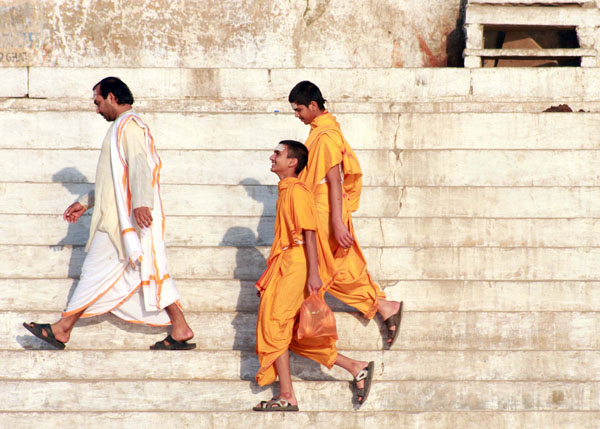
Waking up early in Varanasi is a decision nobody regrets. Around 5 in the morning, while it is still dark, the ghats — the ancient stone steps that descend to the Ganges river — begin to come alive. Devotees submerging themselves in the cold water, priests chanting mantras, photographers with cameras poised, and occasionally a funeral boat drifting silently downstream.
Hiring a wooden rowboat to glide past all 84 ghats at sunrise is, without question, the single most iconic experience of any trip to Varanasi. The cost ranges from 800 to 2,000 rupees depending on duration and whether it is private or shared. Book in advance during peak season (October to March) because spots fill up quickly.
From the river, the perspective is completely different. You see the city the way priests have seen it for centuries — as a golden line of stone steps where life and death blend without distinction, lit by the first pale light of morning.
2. The Ganga Aarti at Dashashwamedh Ghat
If the sunrise boat ride is the best experience of the morning, the evening Ganga Aarti is the undisputed highlight of any spiritual journey in India. Every evening, as the sun begins to sink over the Ganges, Dashashwamedh Ghat transforms into a stage of fire, bells, incense, and pure devotion.
Seven priests dressed in traditional saffron and gold robes take their positions on elevated platforms and perform a perfectly synchronized ceremony with massive brass oil lamps, conch shells, and Vedic chants. The reflection of the flames dancing across the river creates an atmosphere that leaves many Western travelers speechless for several minutes.
The ceremony lasts between 45 and 60 minutes. In winter it begins around 6:00 PM; in summer closer to 7:00 PM. What remains constant is this advice: arrive at least 45 to 60 minutes early. The ghats fill up fast, and if you arrive late you will spend the whole ceremony staring at the back of someone else's head.
You have three ways to watch it: from the stone steps of the ghat itself (the most immersive option), from a boat on the river (ideal for photography), or from a rooftop restaurant overlooking the ceremony. All three have their magic, but standing on the steps surrounded by thousands of devoted pilgrims, feeling the vibration of the chants moving through your chest — that is something no camera can reproduce.
3. The Kashi Vishwanath Temple
On any trip to India that includes Varanasi, the Kashi Vishwanath Temple is an unmissable stop. It is the most sacred temple dedicated to Shiva in the entire country, and it was completely renovated and expanded in 2021 with the Kashi Vishwanath Corridor — an ambitious architectural project that connects the temple directly to the Ganges river.
There is a separate entrance for foreign tourists with fairly strict security checks. Cameras, mobile phones, and leather items are not permitted inside the main temple. Most travelers store their belongings in the lockers available at the entrance. The experience of witnessing thousands of devotees in full prayer, with the constant sound of bells and the thick scent of incense filling the air, is difficult to compare to any place of worship in the Western world.
4. Manikarnika Ghat: Where Death Has a Different Meaning
This is the most complex experience to describe and, at the same time, the most memorable part of any trip to Varanasi. Manikarnika Ghat is the city's main cremation ground. Bodies are cremated here continuously, 24 hours a day, every single day of the year. From the river, you can see the funeral pyres burning, smoke rising steadily into the sky, and families carrying out the final rites with a calm solemnity that carries none of the theatrical grief we might expect in the West.
For Hindus, this is not a place of sadness. It is a place of liberation. Families who bring their loved ones to Manikarnika do not weep, because they know they are giving their dead the greatest gift possible — a direct passage to moksha.
As a Western traveler, it is essential to approach this place with complete and genuine respect. Do not take out your phone to photograph. Do not ask questions out loud. Simply observe with the humility of someone witnessing something sacred that does not belong to them.
5. Sarnath: The City Where the Buddha First Spoke
Just 10 kilometers from Varanasi lies Sarnath, one of the four holiest sites in Buddhism in the entire world. This is where Siddhartha Gautama, freshly enlightened, delivered his very first sermon and set in motion what Buddhists call "the turning of the wheel of dharma."
Adding Sarnath to your trip to Varanasi multiplies the historical and spiritual value of your visit enormously. The Dhamek Stupa, built in the 6th century, still stands surrounded by gardens where Buddhist monks from across the world come to meditate. The Sarnath Museum holds some of the most important archaeological pieces from ancient India, including the famous Lion Capital that today serves as the national emblem of India.
The excursion fits easily into half a day: take an auto-rickshaw from central Varanasi (about 30 to 40 minutes) and return in time for the evening Ganga Aarti. Perfect.
6. The Lanes of the Old City
The real Varanasi is not found at its main ghats. It is found in its galis — the medieval alleyways that wind through the old city like a labyrinth of stone and spices. Here you will find shops selling Banarasi silk (one of the most famous textiles in India), vendors of lassi (the thick yogurt drink that has a legendary reputation in Varanasi), tiny temples hidden behind doors you could easily walk past, and the daily life of a city that has remained essentially the same for centuries.
Getting lost in these lanes is, in itself, one of the most honest answers to the question of what to do in Varanasi. You do not need a guide or a map. Just walk, observe, and allow yourself to be fully present in a place where time seems to operate by different rules.
Practical Guide: Everything You Need to Know Before Your Trip to Varanasi
When to Go
The ideal season for a trip to Varanasi is between October and March. The weather is cool and dry, perfect for walking the ghats and exploring the old city without collapsing from the heat.
Avoid April through June, when temperatures can exceed 40–45°C. The monsoon (July to September) floods some of the ghats and can seriously disrupt the experience, though accommodation discounts during this period are significant — often 50 to 70% off peak prices.
If the timing works for you, plan your spiritual journey to India to coincide with Dev Deepawali, which usually falls in November. It is the "Diwali of the Gods": over one million clay lamps illuminate all 84 ghats simultaneously along the Ganges. It is an image very few people ever forget.
How Many Days Do You Need?
Three to four days is the recommended minimum to experience Varanasi with any real depth. With two days you see the highlights, but without the breathing room for the spontaneous moments that are often the most memorable. If your trip to India is tight on time, prioritize at least three nights here.
A basic itinerary might look like this:
- Day 1: Arrival and orientation. Evening walk along the ghats. Ganga Aarti at Dashashwamedh.
- Day 2: Sunrise boat ride. Kashi Vishwanath Temple. Old city lanes. Evening Ganga Aarti.
- Day 3: Day trip to Sarnath. Free afternoon at the quieter ghats. Manikarnika at dusk.
- Day 4: Subah-e-Banaras (the dawn ceremony at Assi Ghat). Silk markets. Departure.
How to Get There
Varanasi has its own airport — Lal Bahadur Shastri International Airport — with direct connections from Delhi, Mumbai, and other major Indian cities. The flight from Delhi takes approximately 90 minutes.
By train, Varanasi is well connected to the rest of the country. The journey from Delhi on the Vande Bharat Express takes around 8 hours. Book your train tickets 60 to 90 days in advance during peak season, as they sell out quickly.
Where to Stay
The best decision for any trip to Varanasi is to stay close to the ghats. Options range from budget hostels (600–1,500 rupees per night) to heritage boutique hotels with direct views of the Ganges (8,000–38,000 rupees per night).
For the most authentic experience, look for a haveli — a traditional mansion — converted into a guesthouse. Waking up in a room with a window overlooking the river, with the sound of temple bells drifting in at dawn, is something no international hotel chain can replicate.
How Much Does It Cost?
Varanasi is one of the most affordable cities in India. A mid-range traveler can manage comfortably on 2,500–3,500 rupees per day (roughly 28–40 euros) covering accommodation, food, and local transport. The sunrise boat ride, the Sarnath day trip, and most of the ghats are either free or carry a minimal entry fee.
Cultural Rules Every Traveler Should Know
To make your spiritual journey in India a genuinely respectful one, a few basic rules go a long way:
- Dress: Cover your shoulders and knees when entering temples. A scarf or light cloth is usually sufficient. Many sacred sites require you to remove your shoes before entering.
- Photography: Ask permission before photographing people, especially during rituals or ceremonies. Photography is strictly prohibited at the cremation ghats. At the Ganga Aarti, photography is allowed but should be done discreetly — no flash, and never position yourself in front of pilgrims.
- Attitude: Varanasi is not a spiritual theme park. The rituals you are about to witness are real and sacred to hundreds of millions of people. Approach everything with the humility of a guest, not the curiosity of a tourist.
- Water: Do not drink water from the Ganges or from the tap. Bottled water is your only safe option throughout the city.
- Food: Street food in Varanasi is extraordinary, but take it slowly at first. Start with well-reviewed restaurants and let your stomach adjust gradually over a couple of days.
What Nobody Tells You About Varanasi
There is something that travel books rarely mention when they get to the Varanasi section of a trip to India: this city has the power to shake something loose inside you in ways you were not expecting.
You do not need to be religious to feel what happens on the steps of the Ganges. You do not need to understand Hinduism for the Ganga Aarti to give you goosebumps. You do not need to share any faith for the image of an elderly man bathing in the river at dawn — eyes closed, face completely at peace — to make you think about things you had not thought about in a very long time.
That is how Varanasi works. It puts questions in front of you that you did not know you had.
Many Western travelers arrive in this city with a mixture of curiosity and healthy skepticism, and leave carrying something different. Not necessarily a religious conversion or a mystical revelation. Sometimes just a new perspective on life, on death, on time, on what actually matters. That alone is enough to justify any trip to India that includes Varanasi in the itinerary.
Final Tips for Your Trip to Varanasi
Wake up early. The most extraordinary moments in this city happen between 5 and 8 in the morning.
Put the map away. The lanes of Varanasi are designed to be wandered. Let yourself get lost.
Do not rush. Varanasi has its own pace and it will not adapt to yours. You adapt to it.
Talk to people. The locals of Varanasi are remarkably warm and welcoming to travelers who approach with genuine respect.
Combine it with the rest of your route. Varanasi fits perfectly into a trip to India that includes the Golden Triangle (Delhi–Agra–Jaipur) or continues north to Rishikesh to complete the spiritual experience.
Book your accommodation early during peak season. The best guesthouses near the ghats fill up weeks in advance.
Conclusion: Is Varanasi Worth Including in Your Trip to India?
The answer is yes. Without reservation.
Varanasi is not the most comfortable destination in India. It is not the most photogenic in the conventional sense. It is not the easiest place to process emotionally. But it is, without question, the most honest. It shows you life and death exactly as they are — without filters, without euphemisms, and without the sanitized distance that modern life has taught us to keep from both.
Any genuine spiritual journey in India passes through Varanasi. And any trip to India that skips it will remain, inevitably, incomplete.
If you are still hesitating, consider this: travelers who visit Varanasi rarely describe it as simply "interesting." They say it was an experience they were not prepared for and have never forgotten. In the world of travel, that is everything.


Recent Posts
Trip to India 2027: an adventure worth planning
08-Oct-2026.png)
Los mejores paquetes turísticos sobre el...
02-Jun-2026.png)
.png)
.png)
Los mejores paquetes turísticos para lunas de...
29-May-2026.png)